

The director, openly gay writer, and non-binary star on the popular book series’ queer evolution
By Chris Azzopardi • Photos (submitted) Courtesy Netflix
Phil Graziadei, the openly gay screenwriter behind Netflix’s new queer-inclusive film trilogy based on spook master R.L. Stine’s classic “Fear Street” series, remembers those teen horror-fiction books well. And he definitely remembers them not being very gay.
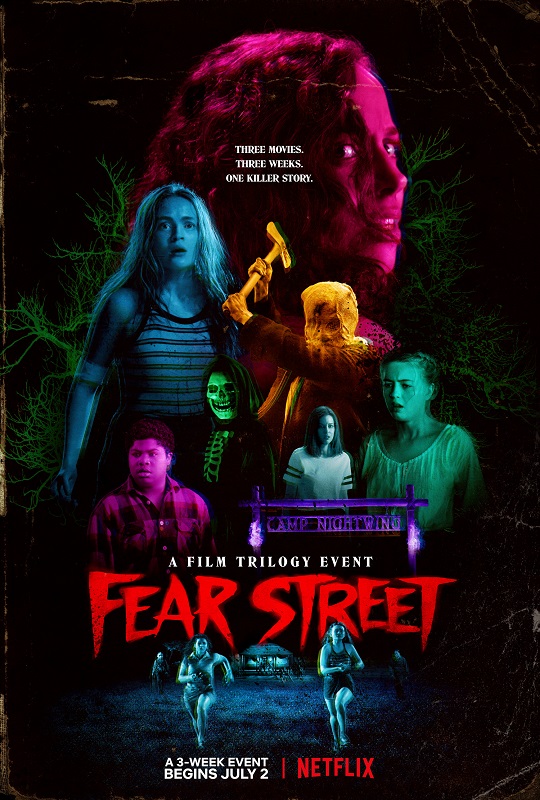
Published first in 1989 with “The New Girl,” the “Fear Street” series focused on whodunit and paranormal events in the town of Shadyside, Ohio. The books weren’t short on sinister camp, but they definitely lacked any kind of blatantly queer representation.
That hasn’t stopped fans, as Graziadei notes, from cataloging “all the homoerotic undertones of each book” for years. In the ’90s, when Stine published bestselling “Fear Street” titles like “Truth or Dare” and “The Boy Next Door,” the LGBTQ+ community was more willing to accept queer crumbs.
But now it’s 2021. On “Fear Street,” bodies might be buried, but queerness shouldn’t be.
“One of the first conversations that I had with the producers about it was, ‘Why do we do this now?’” director Leigh Janiak says.
The answer came to them quickly: Shadyside, they decided, would be a town of outsiders, with a queer love story at the center. That queer couple would not only be the stars of the show — they’d be the heroes. They’d even have a better shot at surviving the terrifying events that unfold throughout each of the trilogy’s parts, which take place in 1994, 1978 and 1666.
“It was very clear to us very early on that we wanted to write this about queer leads,” says Graziadei. “Obviously, queer representation in horror movies has a long and complicated history, for the most part. We’re only seeing ourselves on screen as monsters or as victims. You know, maybe I don’t always want to be the monster. I don’t think that there’s a reason why the queer people always have to see themselves that way.”
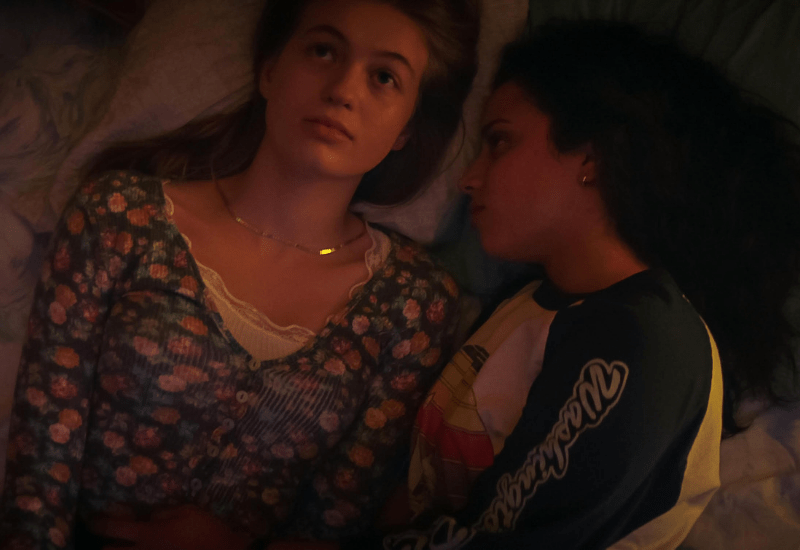
The anthology kicks off with “Fear Street Part 1: 1994,” where we meet Deena Johnson (Kiana Madeira) and Sam Fraser (Olivia Scott Welch) as they’re experiencing a rift in their relationship. Sam is closeted and just moved to Sunnyvale with her mom — the town adjacent to Shadyside, where Deena lives, but nothing at all like the infamous setting for “Fear Street.” Sunnyvale is rich and white. No one gets murdered there. When pure evil is unleashed in Shadyside in the form of a witch who’s haunted the town for eons, Deena, Sam and their cadre of friends go on a deathly voyage through time to solve a nightmare that has haunted the town for 300 years.
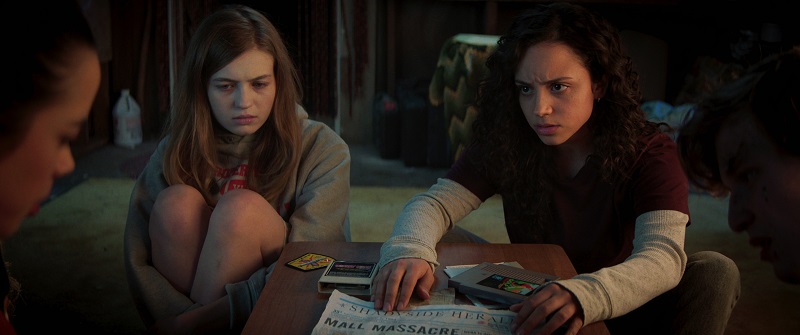
Welch says the queer love story is “very indicative of modern-day cinema and how it’s evolving, and how art is reflecting the elements of society that are becoming very inclusive and encouraging people to be themselves.” It was the “not so boxed in” quality of her and Madeira’s romantically involved characters that particularly appealed to her about “Fear Street,” because, as she and Janiak note, the horror genre still has work to do when it comes to queer representation.
“I hope this is just the beginning of a brand new era in terms of seeing minorities represented in these kinds of roles,” Madeira says.
Janiak and Graziadei, the director-writer team behind 2014’s indie creeper “Honeymoon,” were intentional about having “Fear Street” move the needle forward for LGBTQ+ representation in horror films. Within the heteronormative confines of the horror genre, seeing actual queer people who aren’t victims or villains has been a slow go, and Janiak says that even some of the most enduring horror films haven’t always best represented the LGBTQ+ community.
Janiak, who has directed two episodes of the “Scream” TV series, points to Wes Craven’s iconic “Scream” film, noting that, while an “amazing” horror movie, only white cisgender straight people led the cast. While Graziadei acknowledges some queer coding in “Scream,” Janiak said she thinks that queerness in contemporary horror should go beyond subtext. “Coding is different than being (fully) recognized,” she says.
That “Fear Street” goes beyond just gay vibes was one of the most exciting parts of starring in the summer camp-set “Part Two: 1978” for non-binary actor Ryan Simpkins, who uses they/them pronouns. Even though the script didn’t identify Simpkins’ Alice character as gay, they believed from the onset that she was. “She’s so heavily queer coded,” Simpkins says, “and working through this character, I just kept coming back to that. And honestly trying to fight that impulse to be like, ‘I think Alice has maybe been in love with her best friend Cindy.’ I kept trying to push that feeling away until I finally embraced it.”
While playing the role, the actor said they didn’t want Janiak or Emily Rudd, who plays Cindy, to invalidate her queer read on Alice. But after shooting, they did ask them how Alice identifies and whether Alice did indeed have a thing for Cindy. They were not wrong: “(Leigh and Emily) were like, ‘One-hundred percent, Alice and Cindy are gay.’”
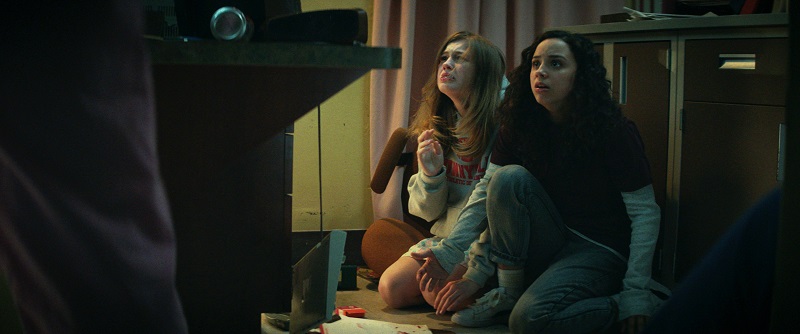
Alice’s queerness aside, Simpkins says of Deena and Sam’s enduring queer love, “It’s so exciting to see a love story between two teenage girls being the main force behind a trilogy of studio movies. Like, that’s crazy, and it isn’t subtle. It’s very explicit. There’s an almost-sex scene!”
“It’s so rare to get these characters whose sexuality is not demonized and isn’t why they’re being punished,” Simpkins adds. “It’s their love for each other that makes them succeed.”
A love that even R.L. Stine was seemingly rooting for. Throughout the trilogy’s development, Janiak had conversations with the author, who she said was “very supportive.” Graziadei also felt that support: “He’s very clearly been like, ‘“Fear Street” is for everybody.’”
Chris Azzopardi is the Editorial Director of Pride Source Media Group and Q Syndicate, the national LGBTQ+ wire service. He has interviewed a multitude of superstars, including Cher, Meryl Streep, Mariah Carey and Beyoncé. His work has also appeared in The New York Times, Vanity Fair, GQ and Billboard. Reach him via Twitter @chrisazzopardi.
 ‘I Wish You All the Best’ Brings Tender Non-Binary Story to Digital November 25
  Madeline Finn to Headline The East Room with Ryan Cassata & Lauren Horbal
  Ty Herndon, Ashley McBryde Join Forces For Powerful Reimagining of ‘A Man Holdin’ On (To A Woman Lettin’ Go)’
  From AGT to Billboard: Wyn Starks drops ‘Dance All Night’
  Nashville Pride Unveils 2025 Festival Lineup: Kim Petras, 4 Non Blondes, Big Freedia & More
  Lips Speak Louder Bring the Noise — and the Heart — on ‘Consolation Prize’